When Nations Unite, Whales Benefit: The Promise of the High Seas Treaty
Feb 11, 2026
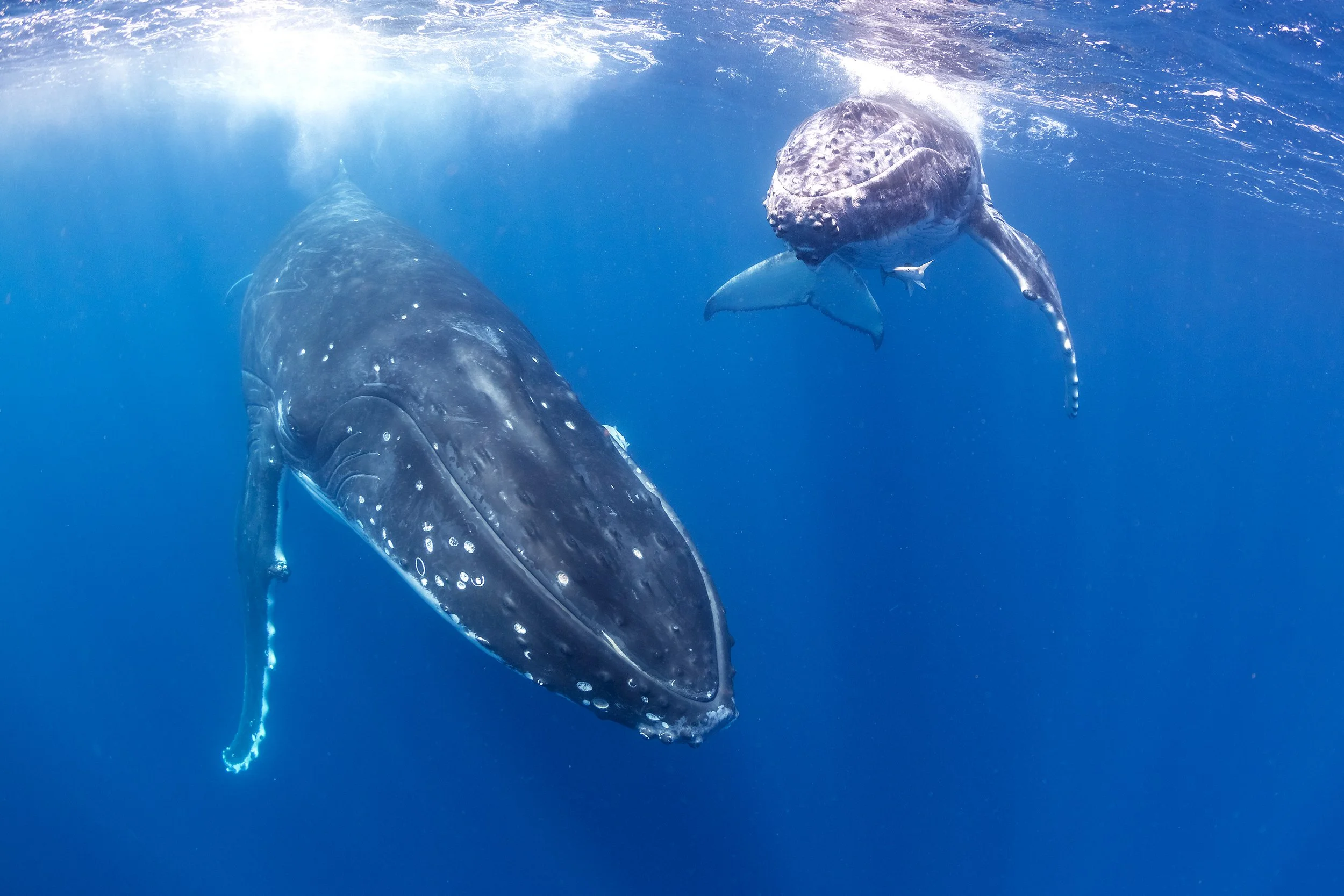
© Ashley Morgan / WWF
A new global agreement to safeguard marine life in two-thirds of the planet's ocean is a lifeline for whales, but the next few years will be crucial.
Every year, whales make perilous journeys across the ocean, weaving between national borders and the vast expanses of international waters called the high seas.
One humpback whale tracked on WWF’s Protecting Blue Corridors initiative, for example, covered nearly 19,000 kilometres over 265 days. It migrated from its summer foraging area near the Antarctic Peninsula, up to its winter breeding area off Colombia, and then back again.
Along the way, this migrating humpback would’ve encountered threats such as ship strikes, underwater noise pollution, industrial trawling, climate change impacts, and fishing nets that can stretch hundreds of metres in length. Indeed, over 300,000 whales and dolphins are estimated to die annually due to bycatch and entanglement in fishing gear alone.
The historic High Seas Treaty has just thrown them a lifeline. After two decades of negotiation, this landmark UN agreement now binds more than 80 countries (so far) to safeguard life in the high seas.
Jessica Battle, a Senior Global Ocean Governance and Policy Expert at WWF International, has been working on the treaty since it was “just a grain of thought in a few peoples’ minds”.
She says that while the treaty itself is a major achievement, the next few years will be crucial for hashing out the details that’ll eventually bring imperilled whales and other wildlife back from the brink.
“Countries have come together to conserve and sustainably use the high seas, and they’ve done that during a period of big global challenges. It really is a beacon of hope that the understanding of a healthy ocean has started to take root. It’s an opportunity for all of us to seize.”
Unchecked waters
The high seas make up roughly two-thirds of the planet’s ocean. Currently, international bodies have managed to protect just 1% of the high seas, most of which is in the Ross Sea in the Antarctic.
Unchecked human activity in this distant realm is one of the reasons almost 10% of marine life is hurtling towards extinction. Almost half of our great whales are still classified as vulnerable due to cumulative impacts across our ocean.
Let's take shipping as an example. Research in Science last year found global shipping routes overlap with 92% of the habitat for blue, humpback, fin and sperm whales. Collisions with vessels kill thousands of whales each year; underwater noise disrupts a whale’s ability to find food using echolocation; and the “unsupervised” dumping of wastewater contaminates their habitat with chemical pollutants.
"The collective human mentality is that the open ocean is this big, limitless expanse. Up until a few decades ago, people thought we could do anything out there – dump our trash, and so forth. It's only recently we’ve realised, oh it’s not so limitless, it’s not so boundless,” Daniel Palacios, Director of the Right Whale Ecology Program at the Center for Coastal Studies, says.
The High Seas Treaty – officially called the Agreement under the United Nations Convention on the Law of the Sea on the Conservation and Sustainable Use of Marine Biological Diversity of Areas beyond National Jurisdiction (BBNJ) – lays the legal foundation to conserve marine life in places that don’t belong to any one nation, but are the responsibility of all. It has four main components:
Marine genetic resources, including questions on the sharing of benefits;
Area-based management tools, including marine protected areas (MPAs);
Environmental impact assessments; and
Capacity-building and transfer of marine technology
The second component – enabling states to establish MPAs in the high seas – is essential to protect 30% of the ocean by 2030, a goal set under the 2022 Kunming-Montreal Global Biodiversity Framework. This means well-connected networks of ecologically representative protected areas can soon be created across national and international waters, creating meaningful links between key habitats for whales and other wildlife.
Protecting whales in practice
Where exactly MPAs and other conservation protection measures will be established and how they’ll be managed has yet to be identified. That won't be easy.
Daniel explains that unlike coastal habitats such as coral reefs, biodiversity hotspots in the high seas are often "moving targets”. An area teeming with marine life can expand, shrink or shift depending on currents and the season.
One example of a shifting hotspot is in the tropical Pacific. Every winter, more than 1,000 blue whales travel from outside California to the Costa Rica Dome, a unique zone in the high seas off Central America that’s rich with nutrients.
Currently, there are no measures in place to limit busy commercial shipping traffic charging through. The largest animals to have ever lived are no match against even larger cargo ships sailing between the Panama Canal and the US West Coast.
“Shipping traffic globally is increasing greatly. Those vessels are being built bigger, tougher, stronger, faster. The faster it goes, the risk of injury to a marine animal goes up exponentially,” Daniel says.
Even slowing down ships to less than 10 knots, for example, would significantly reduce the number of whale deaths from collisions and turn the volume down on underwater noise.
The threat of shipping traffic on marine life – alongside overfishing, pollution, climate change and emerging threats such as deep seabed mining – cannot be solved by one nation. The High Seas Treaty will facilitate coordinated action among states to address these threats, giving these endangered giants and other species a fighting chance to recover.
Hope lies in collaboration
The High Seas Treaty is an extraordinary milestone for ocean conservation worth celebrating, Jessica Battle says. In fact, a particularly important part of the treaty is countries’ commitment to collaborate closely, a measure called “enhanced cooperation”.
Thanks to WWF’s advocacy, enhanced cooperation is a central tenant of the High Seas Treaty.
It will see countries collaborate alongside various maritime bodies, from regional fishery management organisations to conservation bodies. Only by working closely together, under a shared ambition, will we see holistic, integrated and ecosystem-based governance of the ocean.
“This collaboration is actually huge! It’s only through this integration that you can address threats to migratory species,” Jessica says.
The success to date, however, is no reason to get complacent. With the mechanics of the treaty being fleshed out in coming years, including at upcoming COPs, it’s more important than ever to fight for strong policies within, and between, nations.
“We can’t be pollyannaish about this. But hopefully, we’ll see the first generation of high seas MPAs as soon as possible.”